
Multilingual website development
If you also work outside the Netherlands, a second language is often the difference between being found and staying invisible. Provided it is set up properly.
- Own address
- Per language
- Example
- This site itself
Where it usually goes wrong
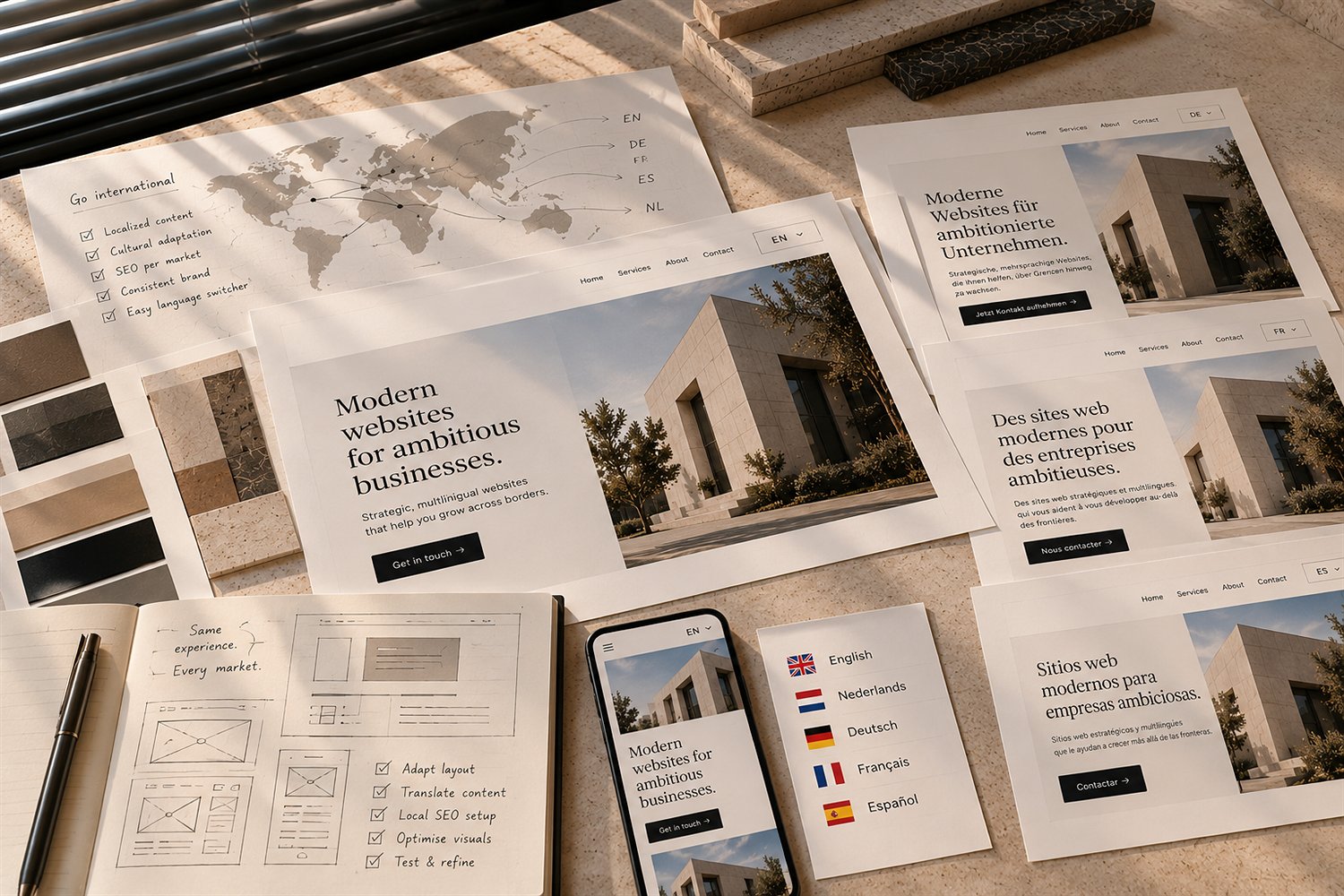
A translate button is not a multilingual website
The cheap solution is a button that swaps the text in place. For a visitor that works, but for a search engine that second language does not exist: there is only one address, so there is only one version to find.
-
Each language its own address
So a search engine can index the English page separately and show it to people searching in English. On this site you see that in the difference between /diensten/ and /en/services/.
-
Links between the versions
With hreflang you tell the search engine which page is the counterpart in another language. Without it, your own pages compete with each other.
-
Translated, not machine converted
Machine-translated sales copy reads like machine-translated sales copy. We rewrite per language, so it sounds like it was meant that way.
-
Legal texts stay in the source language
We do not casually translate terms and conditions: a translated set of terms is legally not the same text. We link to it stating which language applies.
Which language makes sense for you?
Dutch covers the home market. Work outside the Netherlands and the second language depends on where your customers are, more often French or German than English. English pays off when you serve international clients, or when your customers in the Netherlands are largely expats.
Selling into Germany, German weighs heavier than English. We decide that together, based on where your customers come from rather than on which language seems most obvious.
- The Netherlands
- Dutch
- French-speaking market
- French
- International
- English
- German market
- German
Common questions
About multiple languages
Does a second language cost twice as much?
No. The design and the technology are made once. What is added is writing the copy in the second language and the extra testing. That is a substantial effort, but not a doubled one.
Can I add a language later?
Yes, provided the site is set up for it from the start. We structure it so a third language can be added later without rebuilding everything. Do mention it in the first conversation, because converting afterwards costs more.
Does every page have to exist in every language?
Not necessarily. It is often sensible to translate the commercial pages fully and keep the legal pages in the source language, clearly marked as such. That is how this site works too.
Which markets do you want to serve?
Tell us in the quote form, and we will advise which languages are worthwhile and what that means for the setup.